HepaScreen Breath Diagnostics Technology
Inventive Leap was engaged as part of an Enterprise Ireland Commercialisation Fund feasibility study to assess the commercial potential of the technology and identify viable routes to market.
Client
Dublin City University
Sector
Medtech
Publication Date
10 de abril de 2026
Opportunity
Ammonia is a clinically recognised biomarker associated with impaired liver function and hepatic encephalopathy. However, despite its diagnostic relevance, ammonia testing remains underutilised because current methods rely on invasive blood tests and laboratory processing, making frequent monitoring impractical outside hospital environments.
Globally, an estimated 120 million people live with advanced liver disease, with approximately 12 million having experienced at least one decompensation event such as hepatic encephalopathy. These patients are at high risk of recurrent hospitalisation and frequently present to emergency departments with neurological symptoms that mimic stroke, resulting in unnecessary admissions and costly diagnostic workups.
A rapid, non-invasive breath diagnostic capable of measuring ammonia levels at the point of care or in the home could significantly improve how these patients are monitored, enabling earlier intervention and reducing avoidable hospital utilisation.
Researchers at Dublin City University, led by Professor Kieran Nolan, developed a novel & highly selective sensing technology capable of detecting ammonia and related amines at very low concentrations. This reaction occurs rapidly at room temperature and can be detected using simple optical imaging systems, enabling highly sensitive ammonia detection without the need for complex laboratory instrumentation.
This discovery provides a powerful new sensing mechanism that can be incorporated into compact devices and disposable sensors for a number of market applications where ammonia/amine monitoring is required.
While the research demonstrated the chemistry and sensing mechanism, the most compelling commercial applications had not yet been clearly defined.
Background
Approach
Inventive Leap was engaged as part of an Enterprise Ireland Commercialisation Fund feasibility study to assess the commercial potential of the technology and identify viable routes to market.
As part of this engagement, Inventive Leap undertook a structured cross-sector exploration of potential markets to identify where the technology could deliver the greatest commercial impact.
This included:
Developing a long-list of potential application areas spanning healthcare diagnostics, semiconductor manufacturing, environmental monitoring and industrial process control.
Conducting customer discovery interviews with clinicians, hospital administrators, semiconductor industry experts and environmental monitoring companies.
Evaluating each opportunity against criteria including technical feasibility, economic value, regulatory complexity and adoption dynamics.
Through this process the team identified clinical breath diagnostics for liver disease as the most compelling commercial opportunity.
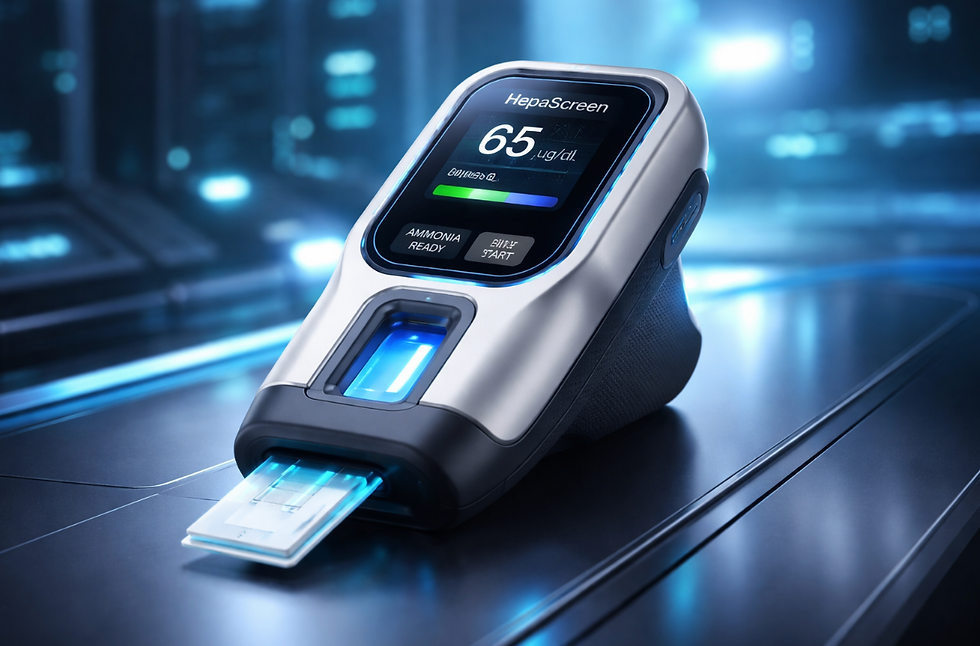
The proposed product concept, HepaScreen, is a handheld breath-analysis device that allows a patient to exhale into a disposable test strip containing the sensing chemistry. The resulting optical signal is captured by an integrated camera and converted into a quantitative ammonia measurement within minutes.
The device is designed for use both in hospital point-of-care settings and, following validation, in supervised home monitoring environments.

The project clearly demonstrated the commercial potential of the technology as a scalable medical diagnostics platform.
Key outcomes of the feasibility study included:
Identification of a high-value beachhead market in patients with advanced liver disease who have experienced prior decompensation events.
Development of a capital-efficient product concept and business model, combining a reusable handheld reader with low-cost disposable test strips.
Engagement with clinical collaborators and hepatology specialists willing to support future clinical validation studies.
Identification of secondary commercial opportunities in environmental monitoring and industrial sensing that could be pursued through licensing or partnerships.
The project established a credible pathway toward spin-out formation and commercial deployment, transforming a novel piece of sensing chemistry into a practical diagnostic platform capable of improving patient care while reducing healthcare costs.